
Google Research has introduced DeepCrossAttention (DCA), an architectural improvement to transformer networks presented in an ICML 2025 paper that allows models to achieve comparable quality up to three times faster while adding negligible parameters.
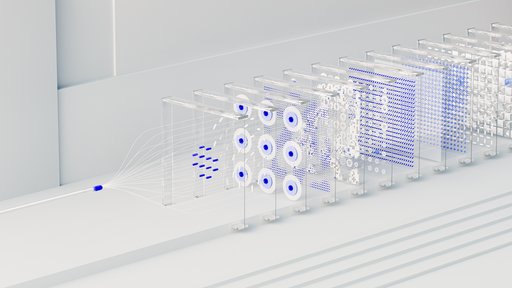
Traditional deep learning models face a challenge as data passes through many layers: the original learning signal degrades, a problem known as the vanishing gradient problem. Transformers address this using residual connections, or “skip” connections, that allow data to bypass complicated layers and be added directly to outputs, preserving access to raw input data.
However, standard residual connections use simple point-wise summation, treating all prior layer representations with equal weight. This leads to information dilution in deep networks, according to Google Research staff scientist Kyriakos Axiotis and principal engineer Thomas Fu. High-resolution details from earlier layers can be averaged out or distorted, forcing the network to recompute them and reducing learning efficiency.
DCA generalizes residual connections by allowing each layer to dynamically select and route features from preceding layers. Rather than a rigid, additive pipeline, DCA reframes residual learning as a dynamic routing problem, using a lightweight, layer-wise module that decides how to best combine previous embeddings on a per-token basis. This allows networks to dynamically retrieve high-resolution features from earlier layers, eliminating information dilution.
In testing across synthetic setups, large-scale language modeling benchmarks, and image classification tasks, DCA demonstrated significant improvements in convergence speed, training stability, and final model quality. On the C4 dataset and 1 Billion Word Language Model Benchmark (LM1B), DCA reached standard transformer performance in up to five times fewer training steps. When trained for the same duration, DCA consistently achieved lower perplexity—a measure of how well a probability model predicts a sample—than standard residual connections.
To achieve a perplexity below 14 on LM1B, a standard transformer required 42 layers, whereas DCA achieved lower perplexity with only 30 layers, a 29% reduction in depth and parameter count. DCA adds less than 0.2% additional parameters, making the computational and memory footprint negligible. Because DCA can be initialized to behave identically to standard residual networks, it can be retrofitted onto pre-trained transformers and briefly retrained, improving perplexity by 0.19 on LM1B compared to 0.02 for continued standard training.
Key facts
- DCA reaches standard transformer performance in up to five times fewer training steps on language modeling benchmarks
- The architecture adds less than 0.2% additional parameters to total model size
- DCA achieved lower perplexity with 30 layers compared to standard transformers requiring 42 layers for equivalent performance
- DCA can be retrofitted onto pre-trained transformers without training from scratch