At the foundation of quantum mechanics lies a counterintuitive mathematical framework that describes not what particles are doing right now, but all the possible ways they might behave in the future. This framework centers on a concept called Hilbert space, an abstract domain where quantum physics unfolds.

According to the source, quantum mechanics doesn’t track ordinary objects moving through ordinary space. Instead, it predicts “in exquisite detail” all the possible futures of a quantum object. These possibilities are represented as mathematical arrows called vectors, which point through Hilbert space — what physicist Lucien Hardy of the Perimeter Institute describes as “a direction in a possibility space.”
The development of this framework emerged from a puzzle. In the 1920s, physicists Werner Heisenberg and Erwin Schrödinger each developed seemingly incompatible versions of quantum mechanics. Heisenberg’s matrix mechanics used tables of numbers to calculate probabilities, while Schrödinger’s wave mechanics tracked particle probability distributions. Yet both yielded identical predictions.
John von Neumann, a mathematical prodigy inspired by mathematician David Hilbert’s approach to physics, solved this puzzle at age 23. In 1927, von Neumann published a trilogy of papers showing that Heisenberg’s matrices and Schrödinger’s waves were simply different mathematical representations of the same underlying object: the quantum state. They were as equivalent as 0.5 and ½.
Von Neumann rendered the quantum state as a vector in Hilbert space. Before observation, a quantum object doesn’t have fixed properties but exists in a “quantum superposition” — a combination of all possible properties. A particle might be 99% likely to appear on the left and 1% likely on the right, but its actual position remains undetermined until measured.
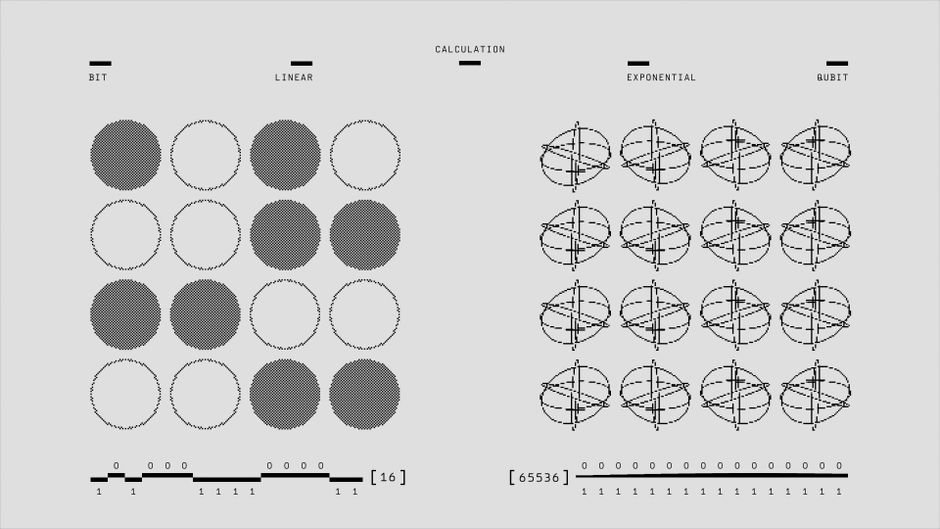
The size of Hilbert space depends on how many possible futures an object has. A particle with two possible outcomes occupies a two-dimensional Hilbert space, while a freely floating particle could be anywhere in the universe, requiring infinite dimensions. Von Neumann established that Hilbert space must be complete and allow calculation of alignment between a state and possible measurements.
Crucially, the axes describing a Hilbert space are arbitrary — chosen by physicists based on what they want to measure. An electron’s state remains the same whether physicists use axes for position, momentum, or energy. This flexibility explains how Heisenberg and Schrödinger’s different mathematical approaches described the same quantum reality, simply rotating their reference frames differently.
Key facts
- John von Neumann showed in 1927 that Heisenberg’s matrix mechanics and Schrödinger’s wave mechanics were equivalent descriptions of quantum states in Hilbert space
- Quantum objects are represented as vectors pointing through Hilbert space, capturing all possible futures before observation
- A quantum object exists in superposition — a combination of all possible states — until observed, when its vector snaps to a definite outcome
- Hilbert space dimensionality equals the number of possible futures; a qubit has 2 dimensions, while a freely floating particle requires infinite dimensions
- The choice of axes in Hilbert space is arbitrary and depends on which measurement a physicist wants to make