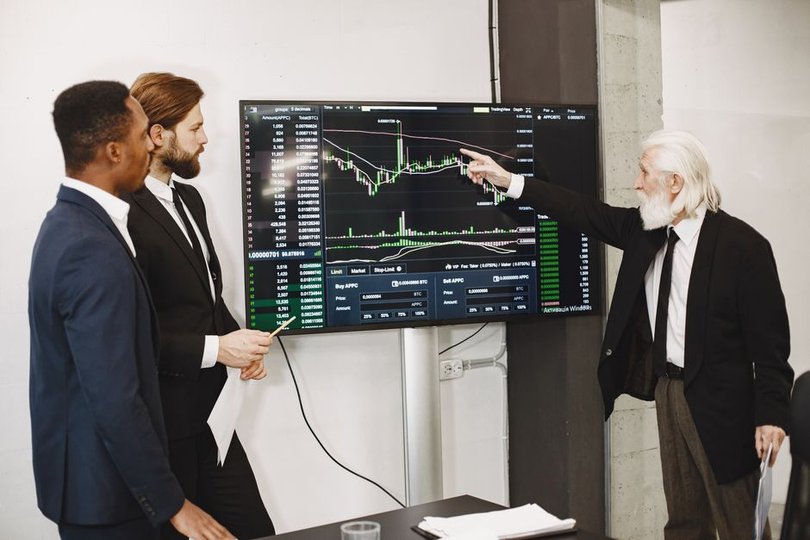
When Michael Bloomberg founded Innovative Market Systems (IMS) in 1981 after being fired from Salomon Brothers, he had a straightforward thesis: Wall Street would pay a premium for specialized financial data delivered through a single integrated system.

At the time, financial information still moved primarily through telephone calls, printed price sheets, and specialist publications. Traders assembled data from multiple sources and performed their own calculations. Companies like Reuters and Dow Jones offered subscription services, but nothing provided the integrated analysis capability Bloomberg envisioned.
Bloomberg, who held an electrical engineering degree from Johns Hopkins and an MBA from Harvard, proposed the Market Master terminal—a monochrome CRT monitor paired with a custom keyboard and communications unit connected to a private network. Initially, it provided only U.S. government bond prices and bond-calculation tools, but the vision extended far beyond: a dedicated desk terminal that could run market scenarios, produce yield curves, and support investment calculations.
Merrill Lynch became IMS’s first client in 1982, investing $30 million for a 30 percent stake and exclusive five-year rights to the terminals. The timing proved fortuitous. Global stock markets were transitioning to electronic trading, and the U.S. Federal Reserve was allowing interest rates to float more freely, making bond prices more volatile. Investors urgently needed tools to accurately value bonds—exactly what Bloomberg’s terminals provided.
The Bloomberg Terminal’s keyboard, nicknamed “the Chiclet,” featured color-coded function keys designed specifically for traders. Hot keys let users quickly access data on government securities, corporate debt, and currency markets. A cable connected the keyboard to the Bloomberg Controller, which used a dedicated phone line to a local hub. Since the commercial internet didn’t yet exist, Bloomberg built its own closed network with centralized computers handling databases and calculations.
By 1984, Merrill Lynch waived its exclusivity rights. Five years after launch, IMS rebranded as Bloomberg LP and began expanding its client base. The company continuously enhanced the terminal: adding a trackball in 1990, a built-in speaker in 1992, support for 23 languages by 1996, and fingerprint authentication in the early 2000s. A particularly popular feature was Instant Bloomberg, allowing users to chat with other terminal subscribers over the proprietary network.
In 1990, concerned that Dow Jones might restrict access to its news, Bloomberg launched its own news service, recruiting Wall Street Journal reporter Matthew Winkler to lead a team. Those stories, featuring graphs and calculations, effectively advertised the terminal’s capabilities. This evolved into Bloomberg’s current media empire including Bloomberg Businessweek, Bloomberg Radio, and Bloomberg Television.
By 1999, a single Bloomberg Terminal subscription cost $1,600 monthly with a minimum two-year contract. Today, annual pricing exceeds $32,000, tracking slightly below inflation.
Key facts
- Michael Bloomberg founded IMS in 1981 after being fired from Salomon Brothers, backed by a $10 million equity payout
- Merrill Lynch invested $30 million for 30 percent of IMS and received the first 22 Market Master terminals in 1982
- The terminal’s custom keyboard featured color-coded function keys designed for traders and used a private network instead of the internet
- Bloomberg launched its own news service in 1990 when concerned Dow Jones might restrict access to its stories
- Terminal pricing in 1999 was $1,600 per month; today annual pricing exceeds $32,000