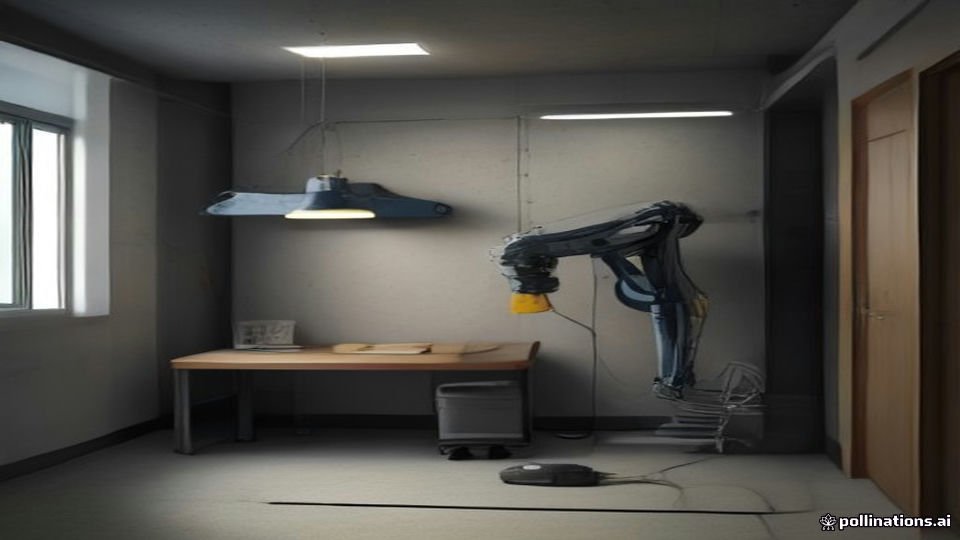
Stringman is an open-source cable-driven gripper robot priced at $795 that uses a novel architecture to access entire room volumes with just four motors. Rather than relying on wheels or legs, the robot hangs its gripper from cables anchored in ceiling corners, allowing it to reach cluttered floors and work areas inaccessible to traditional mobile or robotic arms.
According to the source, the cable-driven design gives Stringman a significant efficiency advantage. While a typical seven-actuator robotic arm achieves 0.32 kg average payload across its work volume, Stringman reaches 1.9 kg average payload across a room up to 7×7×3 meters—roughly 500 times the work area volume per dollar. Maximum payload reaches 2.2 kg near the floor.
The robot is fully open-source and OSHWA certified, with mechanical CAD, PCBs, and control software all published. It operates on local Wi-Fi networks exclusively by default, running AI models on the user’s own hardware with no data leaving the network. An optional cloud relay service exists for remote operation, but users can revoke this access and return to local-only mode at any time.
Stringman’s hardware specifications include two 1920×1080 30fps anchor cameras and one gripper camera at 684×384 60fps. Compute relies on external control via a user’s PC, with Raspberry Pi Zero 2W handling the gripper and Pi 3A+ managing anchors. The robot uses 3D-printed structural parts made from PET-GF and traverses at approximately 0.4 m/s.
The robot incorporates active swing cancellation algorithms to maintain gripper stability during rapid movements without additional motors. A two-finger gripper with wrist articulation provides sufficient dexterity for typical household clutter. Power is delivered wirelessly through one support cable, eliminating the need for batteries and freeing weight for payload capacity.
Stringman works with multiple imitation learning frameworks including LeRobot, Multitask DiT, and others. Training data collection requires as few as 50 episodes for certain models. The robot accepts clip-on fiducial tags to mark destinations like laundry bins or trash cans, and networks can learn to associate verbal labels with tagged locations. Installation requires securing ceiling mounts to wall studs with wood screws or structural columns with ratchet straps, with room heights between 2.3m and 4m.
Key facts
- Stringman costs $795 and uses four motors to cover entire room volumes via cable-driven architecture
- Average payload is 1.9 kg across typical room work area, compared to 0.32 kg for seven-actuator traditional arms
- Robot is open-source with OSHWA certification; hardware CAD, PCBs, and control software are publicly available
- Operates on local Wi-Fi by default with no cloud data collection; optional remote access can be disabled anytime
- Achieves roughly 500× the work area volume per dollar compared to research-grade robotic arms at comparable payload